

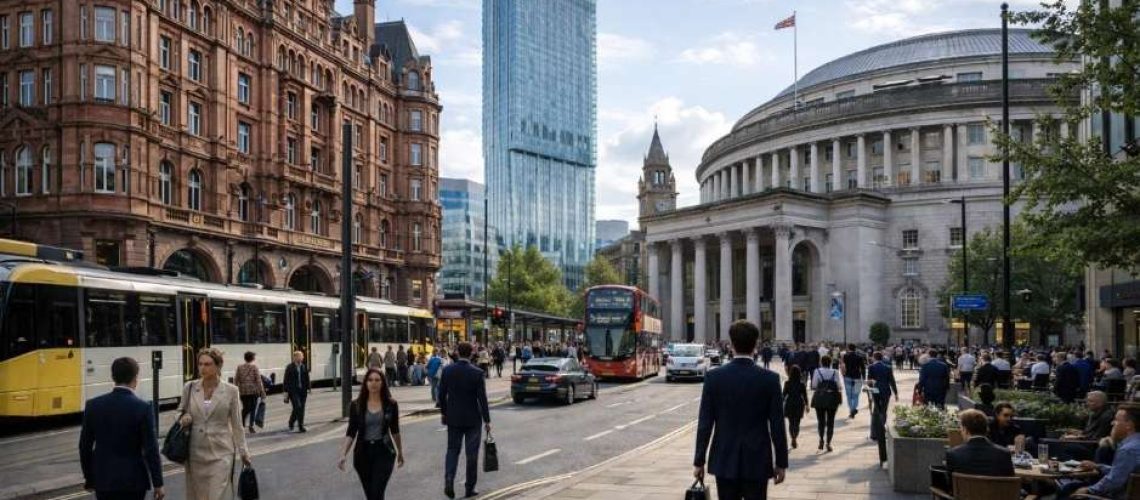
The narrative around the UK office market has shifted.
What began in 2025 as cautious stabilisation has evolved into something more defined in early 2026 – recalibration. The sector is no longer asking whether offices are relevant, but which offices are relevant.
Across the UK, and particularly in core regional cities such as Manchester, demand has consolidated around quality, sustainability and location. The recovery phase is largely behind us. What we are seeing now is selective strength.
The Flight to Quality Has Become Structural
Throughout 2025, leasing activity began to strengthen in prime locations. That momentum has carried into 2026, but with clearer differentiation.
Grade A space in strong city-centre locations continues to outperform. Buildings with robust ESG credentials, high energy performance and meaningful amenity provision are attracting occupiers who view workspace as part of their talent strategy, not just an operational cost.
Secondary stock, meanwhile, faces increasing pressure unless repositioned or refurbished to meet modern expectations.
This is no longer a short-term adjustment. The flight to quality has become structural.
Manchester and the Rise of Regional Prime
Manchester continues to demonstrate why it sits at the centre of the UK’s regional office narrative.
The city’s diversified economy, growing professional services base, and continued inward investment are underpinning occupier demand. Prime space within well-connected locations – particularly around core business districts and transport nodes – remains resilient.
At the same time, development viability constraints and ESG-driven refurbishment costs are limiting new Grade A supply. This creates a dynamic where quality space is not only preferred but increasingly scarce.
For landlords and developers operating in the North West, this environment rewards strategic positioning and long-term asset thinking.
Investor Sentiment – Selective but Returning
Investor appetite has not returned in blanket fashion. Instead, 2026 is characterised by selectivity.
Office assets that demonstrate:
- Strong covenant strength
- Prime micro-location
- ESG alignment
- Long-term income resilience are attracting attention.
The market is no longer pricing offices as a homogeneous asset class. It is pricing, quality, specification and location.
For schemes in Manchester and other core cities, this differentiation presents an opportunity – provided the asset is positioned correctly.
What This Means for Commercial Property Marketing
As the market moves from recovery to recalibration, marketing strategy must evolve too.
Generic messaging around “flexibility” and “hybrid working” is no longer enough. Occupiers and investors are more informed, more selective and more focused on performance.
Successful commercial campaigns in 2026 should:
- Clearly articulate ESG credentials and energy performance
- Emphasise connectivity and micro-location advantages
- Demonstrate amenity depth and occupier experience
- Position the building within the wider economic story of the city
In cities like Manchester, where competition for prime occupiers remains active, differentiation through narrative, branding, and data-led positioning is critical.
The Strategic Opportunity in 2026
The UK office market is not rebounding in a uniform wave. It is consolidating around strength.
For developers, landlords and agents operating in the built environment, 2026 presents a more disciplined but more stable environment than the uncertainty of previous years.
The opportunity now lies not in waiting for momentum – but in aligning assets with the realities of modern occupational demand.
The recalibration phase rewards clarity, quality and confidence.
Sources
- Rightmove, Commercial Insights Tracker, Q1 2025
- RICS, UK Commercial Property Monitor, 2025
- CBRE, UK Office Market Snapshot, 2025
- BNP Paribas Real Estate, UK Economic and Real Estate Briefing